
The Different Drummer
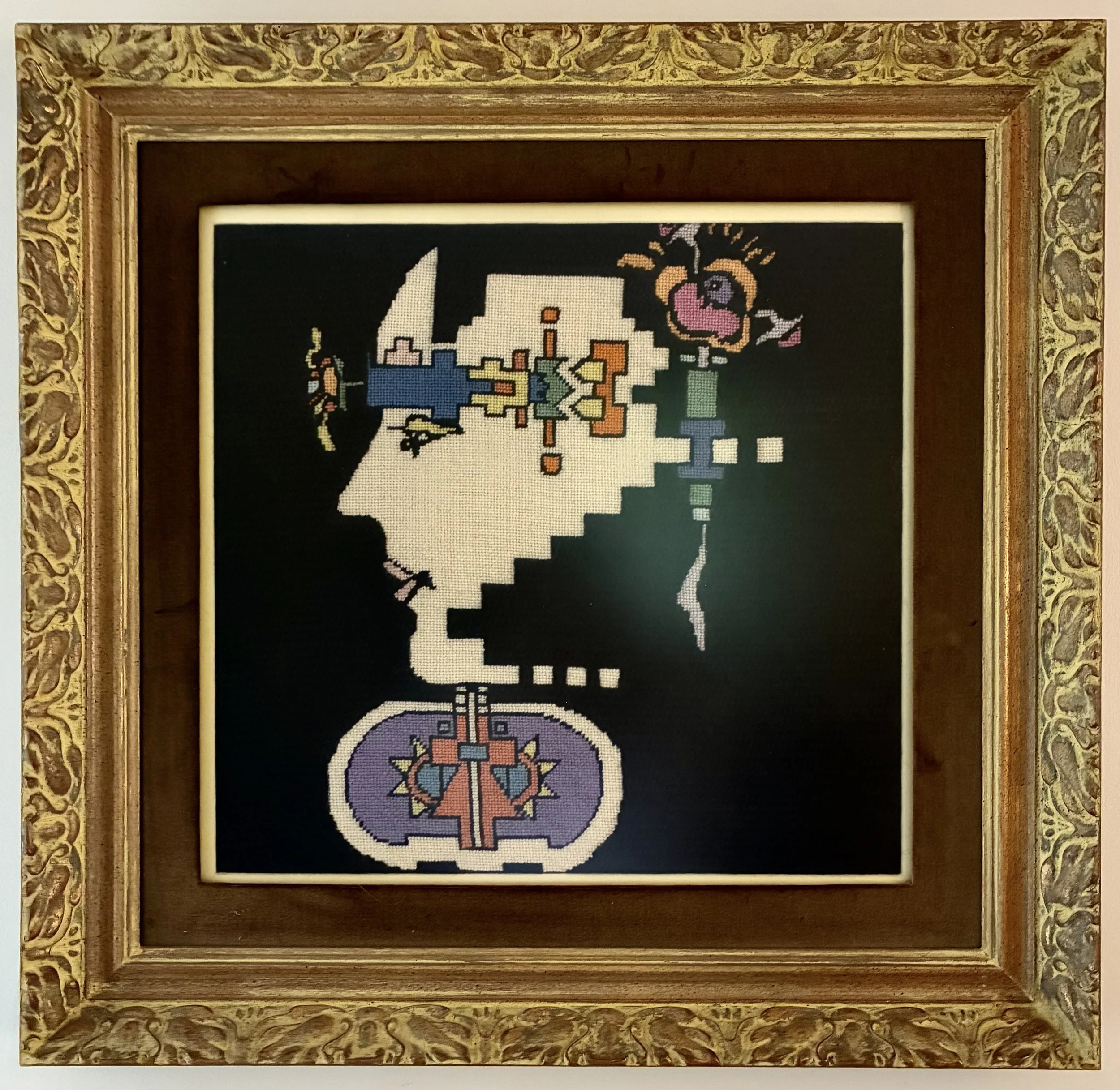
An estate sale listing last fall showed two needlepoint works that I found intriguing, and, while one was unfamiliar to me, I recognized this one as based on the artwork of Peter Max. I dashed to the sale and found them in a basement storage area, framed and remarkably underpriced. The other piece had framing damage (ericas-heirloom-treasures/something-rich-and-strange), but this one was encased in an elaborate gold frame with brown velvet matting. Dear lord – the cost today for such a large frame would be well over $500. I carted them both home, found spots on our walls for them, and began an interesting journey launched with Google’s A.I. Image Search.
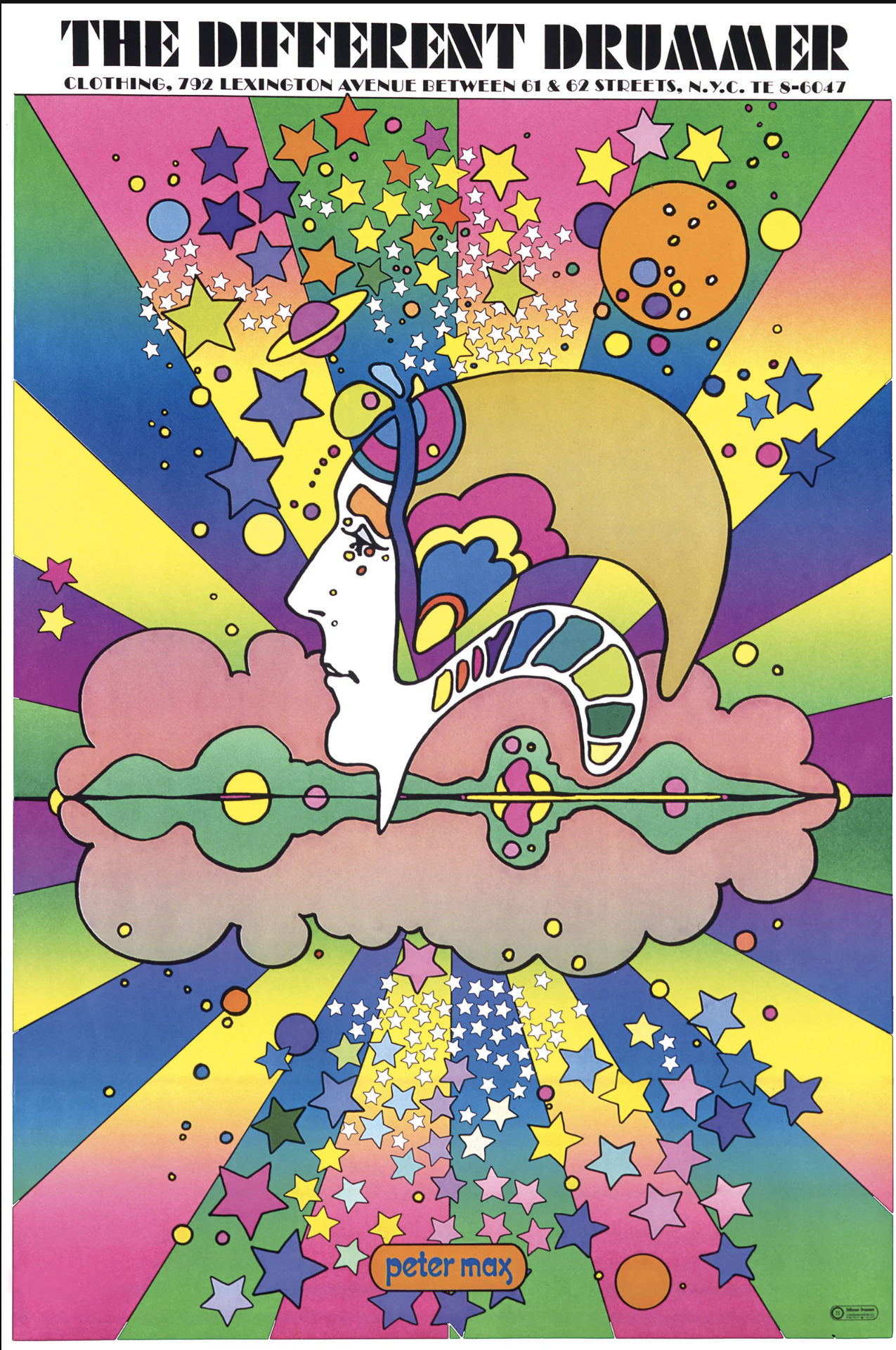
Back in September, 2025 my online sleuthing identified this needlepoint as ‘inspired by’ Peter Max’s “The Different Drummer”. Done in 1968, the artwork was an advertisement for a clothing store in New York City by the same name. The Different Drummer, on Lexington Avenue, was frequented by hippies and rock stars, and became a counterculture destination. The store sold posters of the artwork, and many teens had them glowing in black light on their bedroom walls. The poster is a classic example of Max’s “cosmic art”, with its vibrant color palette, space age imagery and groovy, psychedelic (read: drug infused) peace and love vibe.
Which is, of course, a far cry from the origin of the quote “different drummer”. Henry David Thoreau (1817-1862) was an American naturalist, abolitionist and writer, best known for his 1854 memoir Walden, a reflection of living a simple life in the woods in harmony with nature. It is in that work that he writes:
“If a man does not keep pace with his companions, perhaps it is because he hears a different drummer. Let him step to the music which he hears, however measured or far away”.
A counter-culture, high-end clothing store in Manhattan most likely was not what Thoreau had in mind. But his writing introduced the idiom “marching to the beat of a different drummer”, an idea that one should live according to their own principals and not conform to the expectations of society. The wars in Korea and Vietnam, and a distaste for the politics and cultural repressions of the era, spawned a significant youth counter culture, and Max’s vibrant artwork fit the esthetic. I am starting to understand why this artwork appeals to me.
Peter Max Finkelstein was born in Berlin in 1937, and his Jewish family fled to China in 1938, living there for 10 years. The family moved to Israel and Paris before landing in Brooklyn, NY in 1953. Much of Max’s early art was graphic design work (advertising, book covers, album covers, posters) and he became a sensation after creating a poster for the “Be In” hippie gathering in Central Park in 1967. He even appeared on The Tonight Show in 1968, and his Life Magazine cover in 1969 was headed: “Peter Max: Portrait of the artist as a very rich man”.
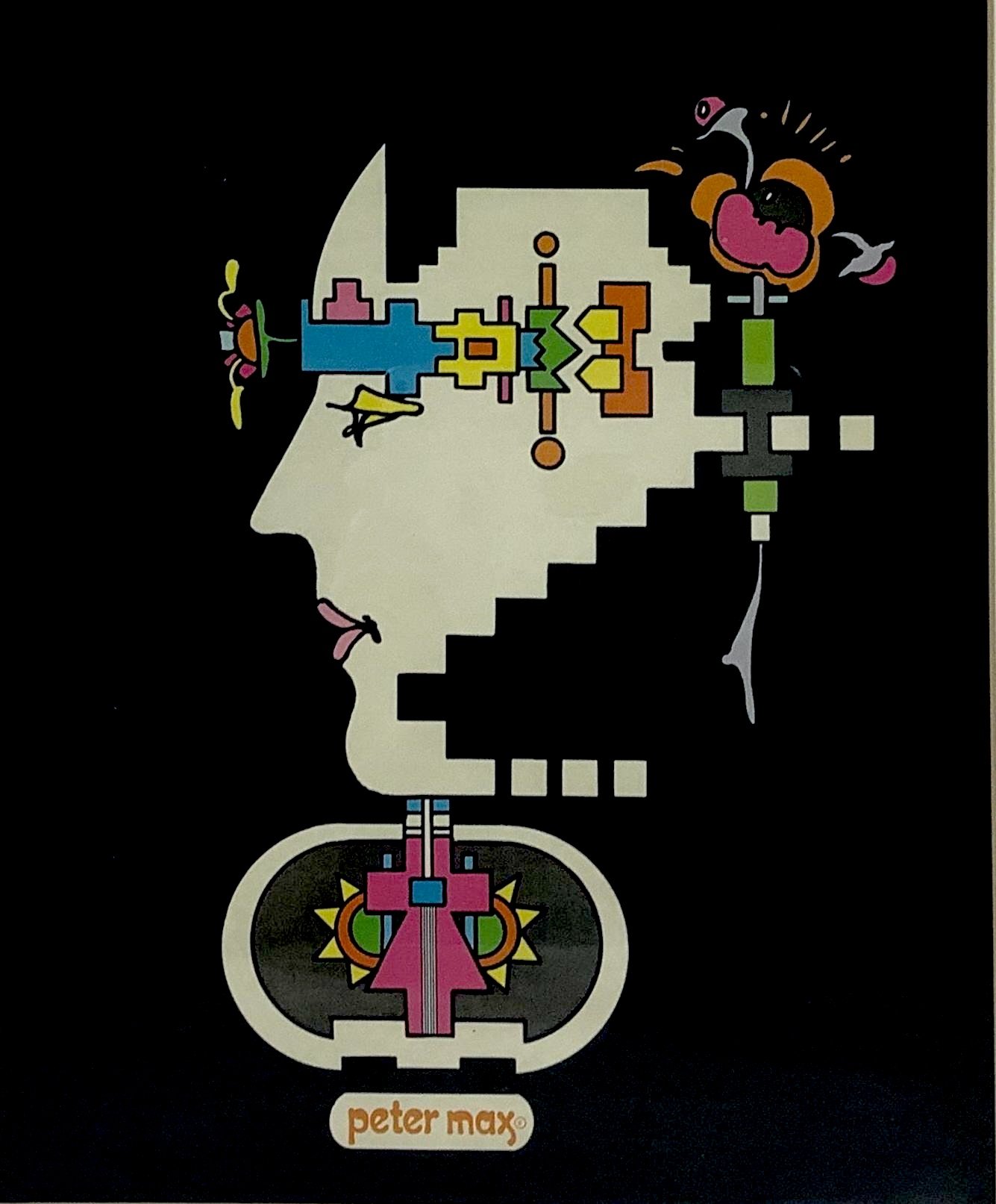
What fascinates me, however, is that an AI image search today quickly located a different work of art, “Geometric Man,” as the needlepoint’s inspiration. I can hardly blame AI for the miss last Fall as I too had not found “Geometric Man”, but the discovery seems apt. Like many artists, Max often repeated images, and his 1973 “Geometric Man” is a close relative to the man in profile depicted in “Different Drummer”. If one searches for “Geometric Man” without the needlepoint image online, Da Vinci’ Vitruvian Man is what shows up, with nary a reference to Max’s work. Da Vinci posited that mankind, while the center of the universe, is built of geometry. Max’s “Geometric Man” shows a more mechanical aspect of mankind, and the popular television show of the era, Six Million Dollar Man (1973-1978), immediately came to mind. The plot featured a NASA astronaut who is rebuilt by the government with bionics after his spaceship crashed. Max’s Geometric Man runs via gears in lieu of a heart, and his brain is composed of cogs and gear shafts spinning a whirligig sprouting from his forehead. Max does, however, include a budding flower in the man’s brainstem, a positive note we can hope reflects our AI-filled future.
By the 1990s, Peter Max’s commercial wheelings and dealings resulted in financial decline, IRS liens included, and he turned to a partnership with Park West Gallery (still in operation), selling artwork on cruise ship auctions. The business model is a tad shady, but was very lucrative for the gallery and the cruise lines, lawsuits and claims of fraud notwithstanding. There was also significant family dysfunction between Max’s second wife and his two children, with claims of abuse, lawsuits, guardianships and – by some accounts – elder abduction and manipulation. A New York Times article in 2019 tells the sordid tale. Sadly, it is an all too familiar tale of greed, and the turmoil left him widowed when his wife committed suicide. (https://www.nytimes.com/2019/05/28/business/peter-max-dementia-cruise-ship-auctions.html) He remains alive, but the value of his art has been impacted by the mass-produced renditions created during these controversial years.
While I found out a great deal about Peter Max, and his sad story, I remain in the dark about the creator of the needlework canvas, nor why they undertook the huge effort and expense to recreate the work in stitching. Both the works I picked up at that sale were created from visually striking examples of 1970s artwork, one done by an unremembered woman, the other by a man who commercialized his artwork during his lifetime and made -and lost – a significant amount of money. I am left wondering if I like the first AI result sending me to “The Different Drummer” more than I like the “Geometric Man” route. The joy of walking in the woods, of finding -and listening to- your own beat is such a basic human experience. The Geometric Man is much more a harbinger of the computer life we now all live, something 1970s counter culture did not predict. Yet Peter Max, who fled Nazis and found his expression in commercially successful artwork, now lives in isolation from a dreadful disease amid myriad lawsuits between his family members. While AI grinds on in infiltrating our lives, possibly we can cling to the flower in our core, and find our own way through the woods.