
A Polish Lion
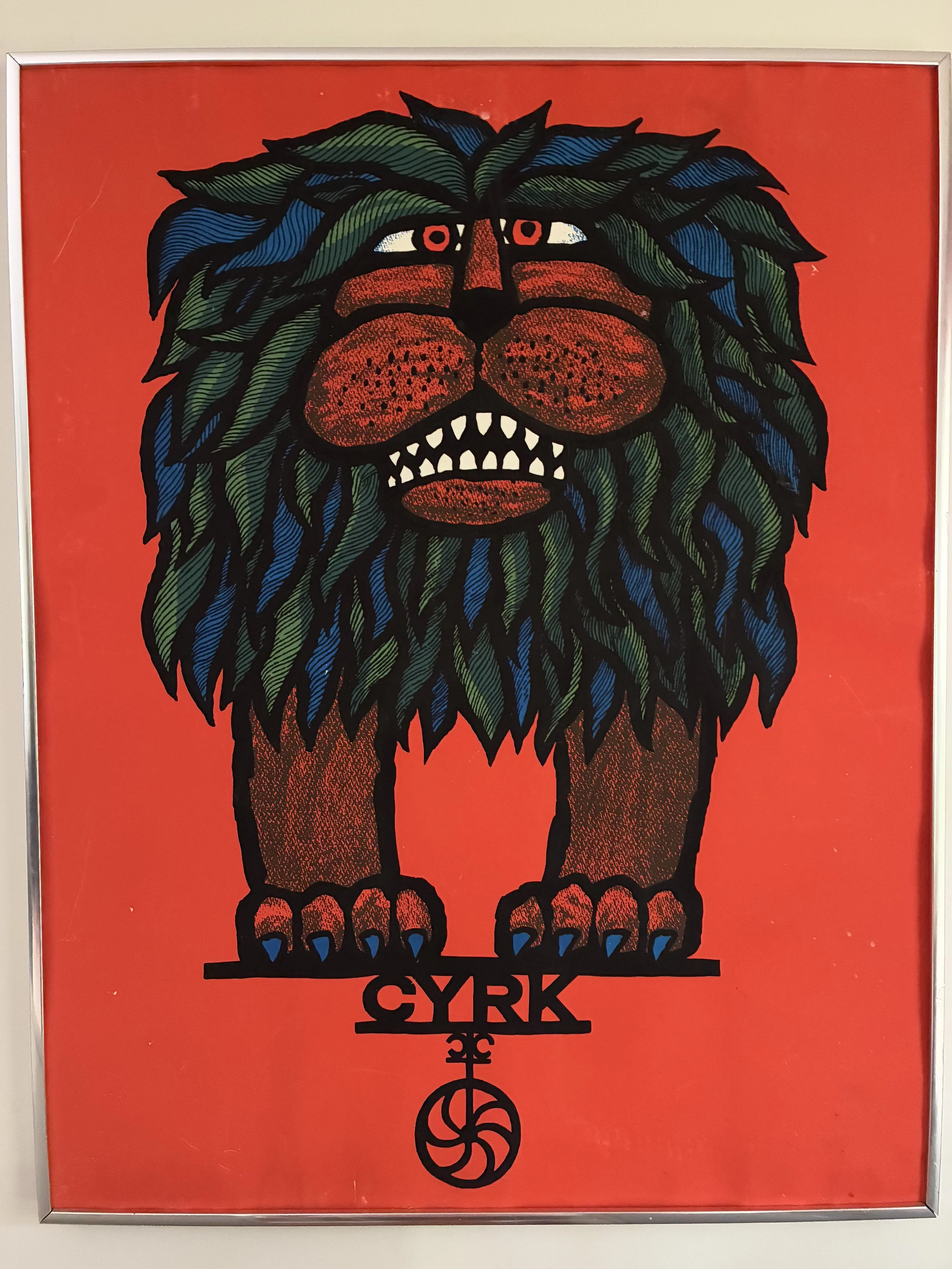
Sometimes a piece of art is really a political statement in disguise. I did not expect this vibrant – and charming – poster of a lion balancing on a small circus ball to be one, however. All I knew was that the colors leapt out at me, the design spoke to my 1970s heart, and the lion was destined to join our circus themed family room.
Last Fall I attended an estate sale at a crowded, tiny house in Barrington. This piece was among the clutter in the ancient, wood garage-cum-shed. The poster was framed but without glass, and practically vibrated across the dim space. I made a beeline to it, snatched it up and carted it inside. Nor did I pause to do any ‘research’ as I basically didn’t care. The poster was not priced so I asked. The response: $7, a rather peculiar number, but I was not arguing. At all. I brought it home, hung it in our circus family room, and was informed by my husband that it was staying right where it was. I guessed ‘cyrk’ meant circus, but I had no idea in what language. Once I began doing research, I realized what a treasure my grinning lion is.
The work is made of three colors: orange, blue and green. Orange and blue are complementary colors (across the color wheel from each other), and much of my family room is decorated with those two colors. Adding green compliments the blue, as they are both cool, calming colors and are ‘analogous’ (next to each other on the color wheel). Not surprisingly, the fireplace in my family room is painted green, and there are many ‘green’ accents in the room as well. The artist effectively created the lion’s textured body by using the background orange and adding black dots. The heavy black outline builds his shape, as well as the charming circus wheel and balance platform.
His whiskers are simply heavier black dots over the orange, but it is the use of white that makes the piece pop. Assuming the original paper was white, the orange ink was laid to create the background, with the areas of teeth and eyes uncolored. The black lines draw in the details, and the animal’s grin is both winsome and childlike. So what is the history behind this remarkable work?
The artist, Hubert Hilscher (1924-1999), was well-known in his day, and was part of the famous “Polish School of Posters”. This art collective began in Poland under communist rule after WWII, and was most famous from 1962 to 1989. The communist government censored art, particularly restricting ‘degenerate’ or ‘western’ art. However, the Polish Ministry of Art & Culture needed posters to advertise their state-run cultural events, including movies, theater, music and circus productions. The Ministry asked the artists at the Warsaw Academy of Fine Arts provide the artwork. The classically trained artists were not enthusiastic, but given the collapse of most commercial business, the artists agreed on the condition they could use their own creative vision. Thus was born the Polish School of Posters (The-Polish-School-of-Posters---A-Remarkable-Period-in-Graphic-Design-History). Hilscher created my grinning lion poster for a circus in 1967.
“Unlike western advertisements, Polish posters were not expected to provide detailed information such as dates, times and locations which were posted elsewhere. The information transmitted was essentially visual” (https://www.kingandmcgaw.com/stories/projekt-26-and-the-polish-school-of-posters). They were easily reproduced on transportable lithographic presses, and plastered all over Polish cities for advertising.
The work was designed to be eye-catching, with hand drawn lettering and unusual design choices, often driven by the lack of commercial marketing (since the communist government was footing the bill). While the artists could not be overtly political, many of the works contained subtle political statements. The use of the lion in my Cyrk poster is a case in point. A lion is often a symbol of strength, pride and defiance, used here as a subtle anti-Soviet nod. Specifically the oversized beast is balanced on a teeny tiny ball – the Soviet state.
The original posters that exist would have been salvaged from the streets, and beginning in 2020, a British commercial printing business, King & McGaw, began reissuing the posters in ’limited runs’. To see some of Hilscher’s works, here’s a link: https://www.projekt26.com/hubert-hilscher). My Cyrk poster was reissued by King & McGaw in 2023, and I have no idea if the poster I own is a true vintage piece or a modern one. Either way, Cyrk will remain watching over my (100% Polish) husband while he sits at his computer in our family room.