Powerful Woman
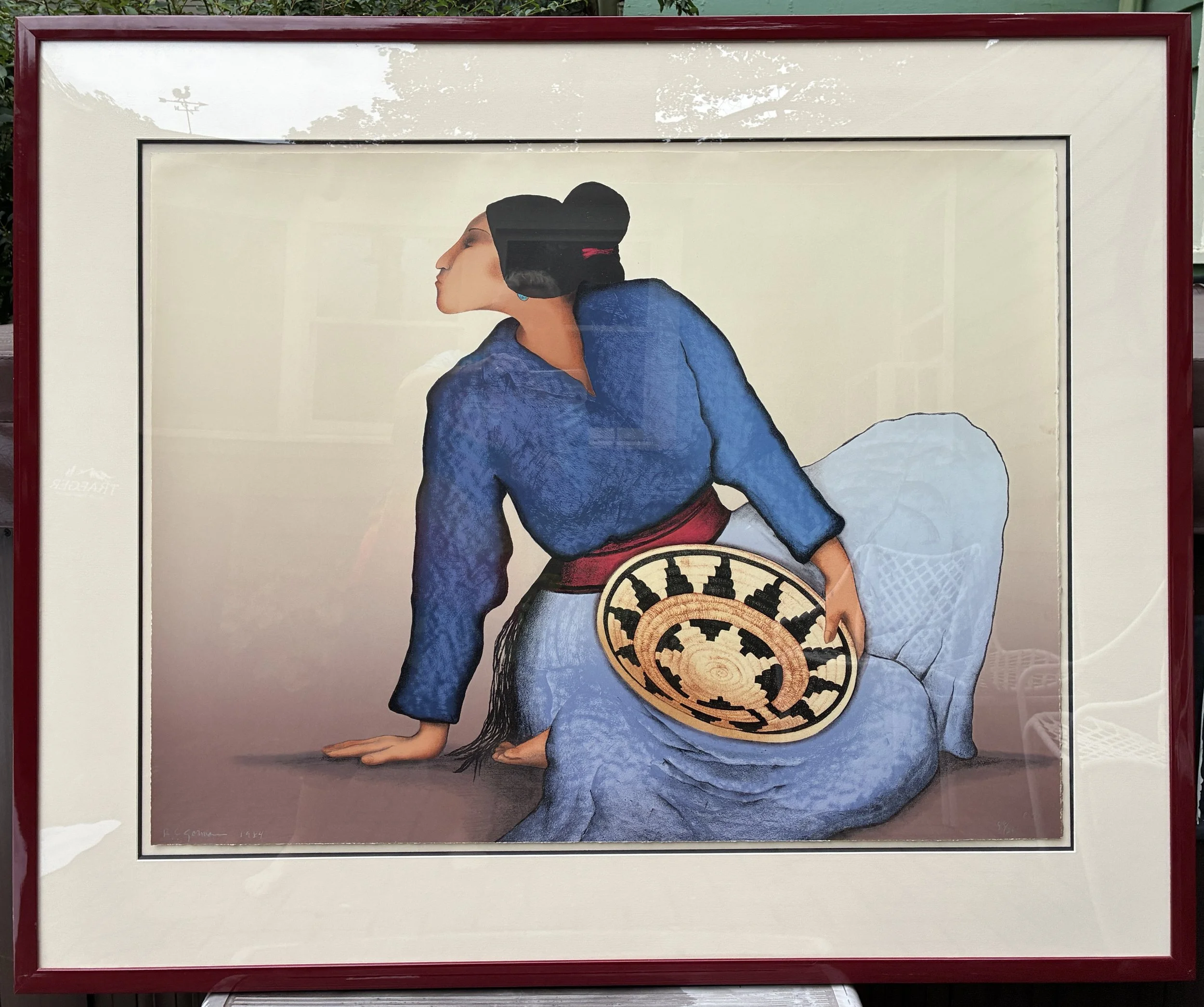
I am not actually feeling much like the above woman. She is Navajo, created by the artist R.C. Gorman in 1984, and currently sitting in my library hall. I wish I had that power pose, but at present, mine is more of an omphaloskepsis slump. The stresses of life have been bogging me down, and I sometimes feel a tad overwhelmed. However, I walk past this artwork multiple times a day, and I swear I can hear her whispering over her shoulder. My troubles are but a speck in the dust of the lives of our country’s Native American residents, and I hear her telling me to get over it. I’m trying, but dang what I wouldn’t give to be engulfed in a blue cloud of a hug.
Recently I had thrifted a large art book about Gorman’s work for $1.00. My husband appreciates Native American history and artifacts, and Gorman’s artwork spoke to both my husband’s interest and my attraction to powerful females in art. As I am decorating a home in Colorado, I decided to lean more towards Native American artwork for the property, and I was inspired by the book to search for Gorman’s artwork at estate sales. Many of his pieces are mass produced, more posters than original signed lithographic works, and I hadn’t found anything that spoke to me.
Recently this piece showed up at a sale. I was unable to make the sale’s first day, but called to confirm the artwork was still available. I arrived early the second day, making a beeline to the room where the art hung on the wall. My gosh is it powerful. She is large (39.5”x 48”) and stunningly framed in a burgundy frame that compliments her belt. Thankfully the family that framed her in Highland Park, IL chose to use acrylic instead of glass, so I was able to carry her out of the sale. I paid an astonishingly cheap amount, especially for an original numbered and signed work (88/200). She rests at present in our library, though she is slated to move to our CO home later this year, where she will preside over the living room space.
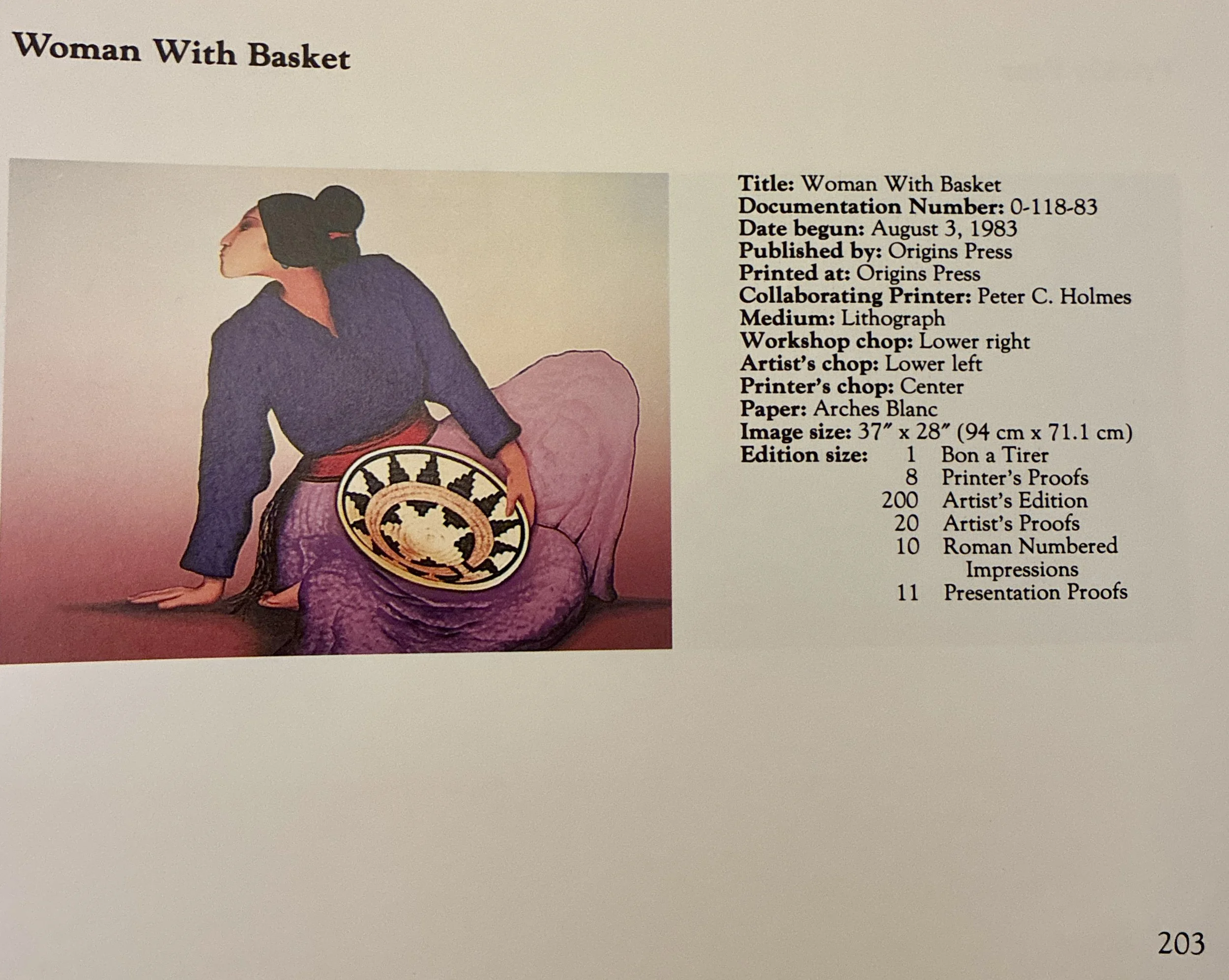
R.C. Gorman (1931-2005) was an artist the New York Times referred to as the “Picasso of American Indian artists”. Gorman was Navajo, raised in Arizona by his grandmother, and drew from a young age. His father, Carl Gorman, was one of the original ‘Navajo code talkers’ from WWII, and was an artist as well. Gorman’s primary medium was stone lithography, and he made over 500 works, of which this is one, titled “Woman With Basket”. It is actually in the book I thrifted, published in the 1990s.
R.C.’s focus was almost exclusively Native American women, and his art style was inspired by Diego Rivera, who he learned of while studying in Mexico in the 1950s. Gorman was very successful during his life time, and participated in the 1973 Metropolitan Museum of Art's Masterworks from the Museum of the American Indian show. He was the only living artist to be included in the show and his artwork was used for the front and back cover of the show's catalog. His stone lithographs sold for thousands of dollars when first issued, and this specific one sold for over $2500 back in 1984.
Gorman was remarkable in his use of color, and his lithographs evolved over time to include incredible texture and pattern. The color pallet Gorman used for “Woman with Basket” struck me – while the one in the book depicts her wearing a purple skirt with blue shirt, mine has changed to wearing all blue. This would have been an intentional choice by the artist in the printing process. Blue historically symbolizes divinity, purity, and supreme grace, largely rooted in the traditional depiction of the Virgin Mary in art. My woman is certainly graceful, but there was a modern interpretation of blue clothing which Gorman may have been looking towards as well, reflected by “Pablo Picasso's Blue Period—monochromatic blue clothing on women…expressed profound sorrow, vulnerability, isolation, and psychological weight.” (https://melissarathmillinery.com/blogs/colour-theory/the-symbolism-of-blue). Given my current state of mind, and the history of Native American women in our country, the second interpretation doesn’t seem far off the mark. That said, Woman With Basket is powerful, and her whispering is most certainly more sass than sorrow. I will do my best to listen.