
In Our Hearts We Know We’re Right (1973)
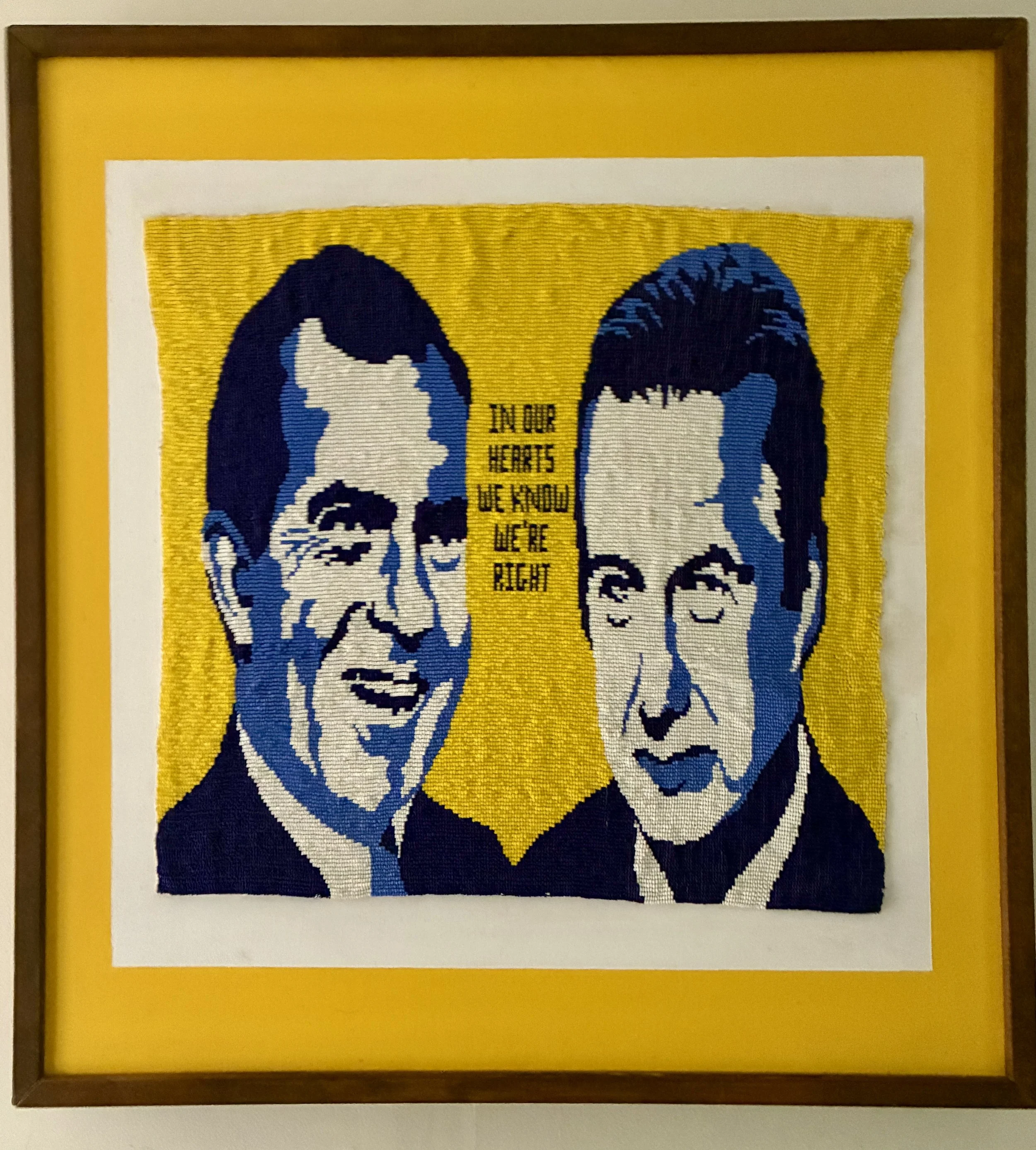
The dilapidated barn I was poking through in Big Bend, WI a few months back was not a typical estate sale hunting ground. Nor was the remarkable piece I found, which I promptly carted home, cleaned, repaired, and hung on our family room wall. Some research was required as I tried to make sense of the work, and determine the artist’s intention. The artwork speaks to the sadness I feel for the moral failings of our current political administration, and I sense the artist was addressing the moral failings of her generation of politicians, though I could be wrong. The piece doesn’t say, but it does say quite a bit all the same.
The estate sale was at a very rural house, tucked amid farm land and winding roads, an hour north of me. While it was a small building, it had a remarkable collection of antique treasures. I snagged some goodies, and others I passed up, including cobweb-strewn duck decoys from a long-defunct business piled on rows of shelves in the dank, field stone cellar. After paying for my goodies inside the home, I noticed farm buildings out back. I am not one to shy away from a good hunt (see cobweb dank basement above) so off I went to explore.
There were various small sheds, though the large, dilapidated, timber frame barn was calling to me. It was maintained well enough to be standing, hadn’t seen animals of the domestic type in ages, and was full to bursting. Cobwebs, sawdust, old trunks, slabs of wood, broken down tools and old building parts. But among the broken dressers, old painted doors, hand forged fireplace tools (snagged by someone else), I saw this piece. It quite literally glowed, leaning against a pile of wood. I kept looking back at it as I wandered through the space, and I regret not taking a photo ‘in suite’ as it stood out so completely it was hard to avoid. It was in pitiful shape: muted with dust, draped in cobwebs, full of ‘mud dabber’ wasp nests, and animal poop dripping down one side. Also a chunk was gnawed off an underside edge of the handmade wood framing.
I knew immediately it was Nixon and Agnew, having been aware of the political crisis of the 1970s as a girl, so I found the piece fascinating. I had absolutely no idea how it was made, what it was on, or if it had any value whatsoever, but decided I needed to take it home. (My children will be rolling their eyes at this point.) I asked the man ‘working’ the barn – he was outside trying to help someone see if the Toro snow blower would turn on (it did) – how much it was. He decided I really didn’t need to pay for it, so I paid for my other treasures (native American basket, old cow farm sign, Santa-painted barnwood plank, and a 1970s yellow metal yard bench among other tchotchkes) and shoved it all in my car.
When I got home, I took all my barn treasures straight to the garden hose and washed them off, this piece included! The filth that ran down it was moderately concerning. I then grabbed a brush and Dawn dish soap and scrubbed the 5 wasp nests off the back, and the remaining dirt and poop off the front. By this point I realized the piece was beaded – I had thought it was some type of needlework. The beading substrate on Agnew’s side by the bird poop had unraveled, and the tiny yellow beads were coming undone. Much like nylons run when a hole is created, the beads simply kept popping off, with beads scattering here and there. I eventually sewed all the beads I collected back onto the work, securing them with fine thread one at a time, making sure to secure each row so no more would unravel. There are a few missing, but for the most part Agnew will remain unscathed. The same cannot be said for his political reputation.
The entire beaded piece is tacked onto an artist’s canvas which had been painted in yellow and white sections. Thankfully the back has useful information, including a note about the ridiculous amount of beads used. Unfortunately the pencil marks have faded so it is unclear how many beads were used (in the thousands). There is a title: “In Our Hearts We Know We’re Right”. The signature is hard to read, but I think “Dawn M. Busbie” was the artist. The date, however, is clear: 1973. So, now a history lesson is needed.
Arizona Senator Barry Goldwater ran as the Republican presidential candidate in 1964, losing to Lyndon Johnson. Goldwater’s campaign slogan was “in your heart, you know he’s right”. He lost the election by a landslide (winning only 6 states), so apparently voters didn’t think he was “right”. Goldwater then supported the Republican ticket of Richard Nixon and Spiro Agnew in the 1968 election. The artist of this piece adjusts Goldwater’s campaign slogan to have Nixon and Agnew say “in our hearts, we know we’re right”. The use of “right” could be a reference to the political right, supporting Nixon against a ‘witch hunt’ to end his political career. Or the piece could be an ironic reference to the beginning of the Watergate scandal.
News of the Watergate scandal became public knowledge in June, 1972 when 5 men were arrested breaking into the DNC. Agnew, meanwhile, was being investigated by the F.B.I. for political corruption and kickback schemes, stemming from his governorship of Maryland, though investigations showed he accepted cash bribes as the Vice President as well. As the Watergate scandal began to deepen, a nervous Nixon asked Agnew to resign, which he did on October 10, 1973. Gerald Ford, the House Minority Leader then became the VP. Goldwater initially defended Nixon during the ensuing Watergate news, but eventually he led a Republican delegation to inform Nixon the Republicans in Congress would impeach him due to the scandal. Nixon resigned two days later, on August 9, 1974.
Apparently, the current resident of the Oval Office is a Nixon fan who maintained a correspondence with Nixon during the 1980s and 1990s, inviting Nixon to live at his Manhattan Tower and praising Nixon as "one of the country's great men". (https://www.inquirer.com/trump-vance-redeeming-nixon). In addition, in June this year, our current Vice President told an audience that the scandal that provoked Nixon’s resignation would be “like a 12-hour news story” today, adding that “the idea that it would have taken down a presidency is crazy.”(https://www.nytimes.com/2026/06/26/)
Dawn Busbie spent a great deal of time beading this canvas in 1973, well before Nixon resigned. Juxtaposing an adjusted Goldwater slogan with Nixon and Agnew’s portraits to have Nixon and Agnew announce that basically “they’re right” tells me she was showing how the politicians of her day would do whatever they wanted as they felt it was all about them – they were always “right”. And yet another Republican politician stood up to the corruption, calling out the reality that Nixon was not exactly “right” from a moral point of view. The irony of the piece in today’s political climate is a bit hard to swallow – how innocent the Watergate scandal seems. The piece remains silent as to its intention, but in my heart I know I’m right.